Knob-and-Tube Wiring in Older Homes
What every homeowner needs to know about knob-and-tube wiring — safety risks, insurance issues, replacement costs, and when to call an electrician.
Articles on this site may include sponsored content. If they do, it's labeled clearly — and it still has to answer a real homeowner question. Same bar as everything else here.
Knob-and-Tube Wiring in Older Homes
If you own an older home — and by “older” I mean pre-1950, and in many places pre-1940 — there’s a decent chance you’ve got knob-and-tube wiring running through your walls. And if you don’t know what that is, you’re not alone.
Knob-and-tube was the first standardized electrical wiring system used in American homes. It worked fine for its time. But that time was the 1920s through 1940s, when a home’s total electrical load might be a few light bulbs, a radio, and maybe a refrigerator. Today? We’re asking that same 90-year-old wiring to handle LED lighting, home offices, big-screen TVs, air conditioners, and kitchen appliances.
That’s asking a lot. Sometimes it’s fine. Sometimes it’s a fire waiting to happen.
Here’s what you need to know about knob-and-tube wiring — how to identify it, when it’s a problem, what insurance companies think about it, and what it costs to replace.
The TL;DR
Knob-and-tube wiring is an outdated electrical system found in homes built before 1950. It lacks a ground wire, has insulation that degrades over time, and isn’t designed for modern electrical loads. Many insurance companies won’t cover homes with active knob-and-tube, and those that do may require higher premiums or a time limit for replacement. Replacement costs average $8,000 to $35,000 depending on home size and accessibility. If you have knob-and-tube that’s in good condition and not modified, it can be safe — but it needs professional evaluation.
What Is Knob-and-Tube Wiring, Exactly?
Let’s start with the basics. Knob-and-tube wiring gets its name from the two components used to install it:
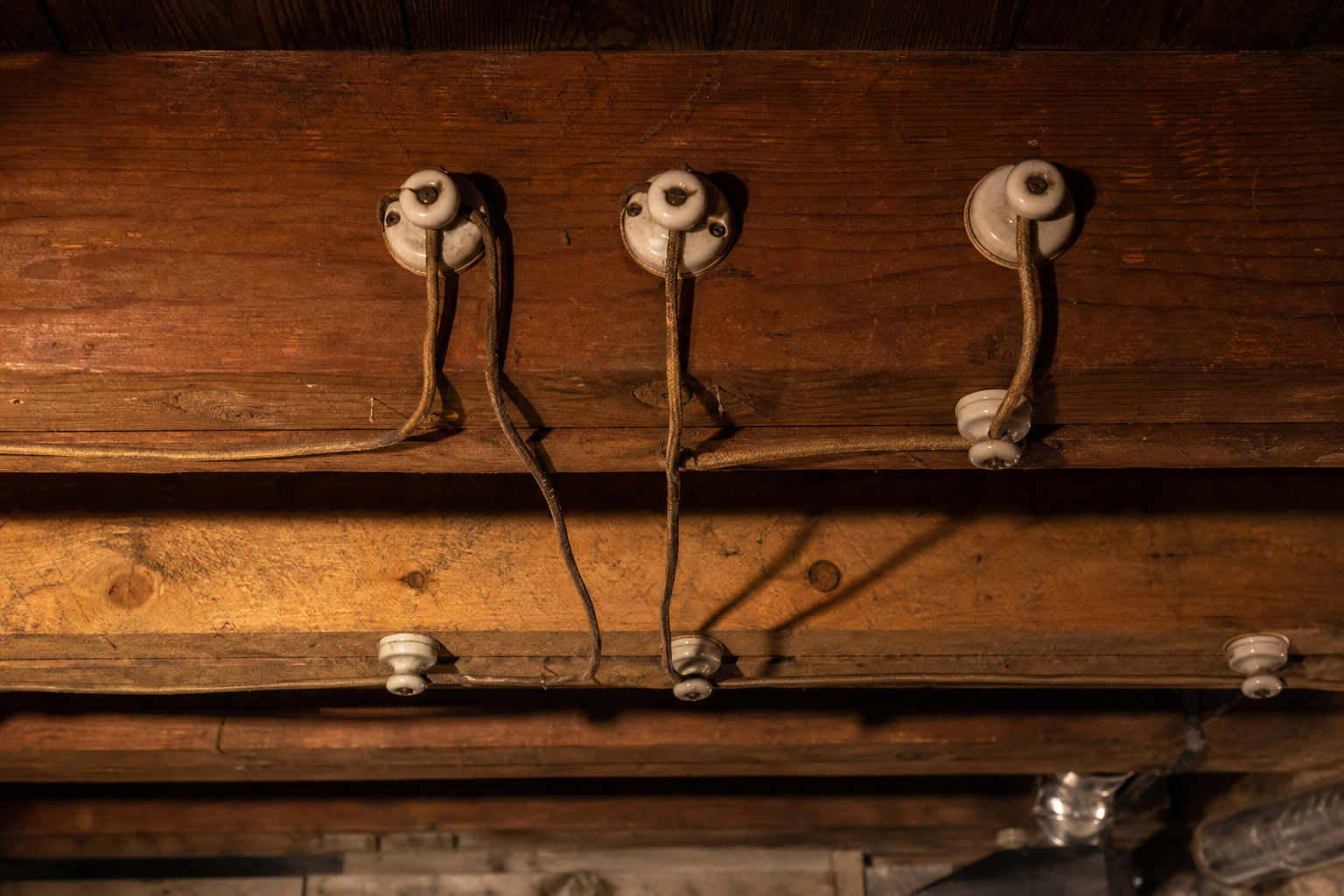
Knobs are porcelain spools that hold wires away from wooden framing (studs, joists, rafters). The wire is wrapped around the knob and secured, keeping it from touching the wood. This was necessary because knob-and-tube predated Romex (modern NM-B cable) — back then, wires were run individually.
Tubes are porcelain cylinders that protect wires as they pass through wooden framing members. The electrician would drill a hole through a joist, insert the tube, and run the wire through it. This prevented the wire from rubbing against the wood as the house settled and shifted over time.
The system uses two separate wires — a black (hot) wire and a white (neutral) wire — run independently. Unlike modern wiring where the hot and neutral are bundled together in a single cable, knob-and-tube wires are separated by several inches. This was actually a clever design, because it allowed the wires to cool more effectively than bundled conductors.
There’s no ground wire. That’s the biggest difference between knob-and-tube and modern wiring. A three-prong outlet requires a ground path. Knob-and-tube doesn’t have one. That becomes important in a minute.
How to Identify It
Knob-and-tube is easy to spot once you know what to look for. If you have an unfinished basement, attic, or crawlspace, go take a look. You’re looking for:
- Porcelain knobs (about the size of your thumb) nailed to the sides of wooden beams with individual black and white wires wrapped around them.
- Porcelain tubes sticking out of holes drilled in floor joists or wall studs.
- Cloth-wrapped or rubber-coated wiring (older knob-and-tube has fabric insulation; later versions used rubber that’s often cracked or crumbling).
- No ground wire — just two wires.
- Wires that are spaced apart, not bundled together like modern Romex.
If you see a jumbled mess of electrical tape, splices, and cloth wire that’s been jerry-rigged into modern outlets, that’s a red flag. Knob-and-tube that’s been modified or “extended” by a previous owner is much more dangerous than original, untouched installations.
Is Knob-and-Tube Wiring Safe?
This is the question I get most often. And the honest answer is: it depends.
Untouched, well-maintained knob-and-tube wiring can still function safely under the right conditions. The porcelain components don’t degrade. The copper wire itself is fine if the insulation is intact. And the open-air design means the wires actually run cooler than modern Romex in some situations.
But — and this is a big but — those conditions are rare in a 2026 home. Here’s what changes the equation:
Age of the insulation. The cloth or rubber insulation on knob-and-tube wiring has a lifespan of about 50 to 80 years. If you’re reading this in 2026 and your home was built in 1930, that wiring is pushing 100 years old. The insulation gets brittle, cracks, flakes off, or becomes “gummy” and sticky. Exposed copper is a short-circuit and fire risk. If the insulation is compromised, the system is no longer safe.
Modern electrical loads. Knob-and-tube was designed for 15-amp circuits at most. Modern kitchens, home offices, and entertainment centers often draw more than that. If someone put a 20-amp breaker on a knob-and-tube circuit, the wire can overheat before the breaker trips — that’s a fire hazard. Similarly, knob-and-tube circuits can’t handle the starting surge of modern appliances like window AC units or refrigerators.
Modifications and splices. The most dangerous knob-and-tube isn’t the original stuff. It’s the wiring that’s been spliced into, extended, or connected to modern Romex by a previous owner who may not have known what they were doing. Sloppy splices, electrical tape wrapped around bare wire, and junction boxes that don’t exist are all too common in homes with knob-and-tube.
Inappropriate modifications. I’ve seen knob-and-tube connected to three-prong outlets with the ground left unconnected. I’ve seen it buried under attic insulation, which traps heat and prevents the wires from cooling properly. I’ve seen it run through walls where it’s been damaged by rodents. These aren’t theoretical risks — they’re the kinds of things an electrician finds during every comprehensive inspection of an older home.
What Insurance Companies Say
This is the part that surprises most homeowners. Many insurance companies will not insure a home with active knob-and-tube wiring. And the ones that do usually come with strings attached.
The insurance landscape has changed significantly in the last few years. As of 2026, here’s the general picture:
- Some carriers flat-out refuse to write a new policy on any home with knob-and-tube, period.
- Others will insure it but require a higher premium (often 10-20% more) to offset the fire risk.
- Some will issue a policy with a 30- to 90-day requirement to have the knob-and-tube replaced and inspected.
- A few carriers will let you keep knob-and-tube if it passes a professional inspection showing it’s in good condition.
The trend is toward stricter policies. A knob-and-tube wiring system that was insurable five years ago might not be today. If you’re buying a home with knob-and-tube, check with your insurance agent before you close. If you already own one, don’t assume you’re covered — check your policy or call your agent.
If you’re told you need to replace the knob-and-tube to maintain coverage, that’s not the insurance company being difficult. It’s them pricing the actual risk. Knob-and-tube wiring fires are rare but real, and insurers have the data to back up their decisions.
Replacing Knob-and-Tube Wiring
So you’ve decided (or been told) that the knob-and-tube needs to go. What does that look like?
The Process
A whole-home rewiring isn’t simple. It involves:
- A licensed electrician assessing the current system and planning the new circuits
- Running new NM-B (Romex) cable through walls, ceilings, and floors to every outlet, switch, and light fixture
- Installing new electrical boxes where needed
- Connecting the new wiring to a new or existing panel
- Installing new outlets, switches, and fixtures
- Disconnecting and removing (or decommissioning) the old knob-and-tube wiring — leaving it in place is sometimes allowed if it’s disconnected, but it must be verified dead
- Patching drywall where access holes were cut
- Passing a final inspection by the local building department
The electrician will need access to the walls, which means cutting holes in drywall or plaster. Some electricians minimize damage by fishing wires through existing wall cavities, but older homes with lath-and-plaster walls make that much harder. You should expect some patching and painting afterward.
The Cost
Replacing knob-and-tube wiring is not cheap. According to 2026 data, the average cost ranges from $8,000 to $35,000 for a full home rewiring, or roughly $8 to $17 per square foot. For a typical 1,500 to 2,500 square foot home, expect somewhere in the $12,000 to $25,000 range.
What drives the price:
- Home size. More square footage means more wire, more boxes, more labor.
- Accessibility. An unfinished basement and attic make the job much easier (and cheaper) than a finished home where the electrician has to work through finished walls.
- Plaster vs. drywall. Plaster and lath is more difficult to cut and repair than drywall, which adds cost.
- Number of circuits. A simple home with minimal outlets costs less than a modernized home with dedicated circuits for the kitchen, bathroom, laundry, and home office.
- Panel upgrade. If your panel also needs upgrading (say, from 60 amps to 200 amps), that’s an additional $1,500 to $4,000.
- Local labor rates. Electrician rates vary significantly by region. Major metro areas run higher than rural areas.
Partial vs. Full Replacement
Some homeowners try to save money by replacing only the “visible” or “accessible” knob-and-tube and leaving the rest. I don’t recommend this. Here’s why: if you replace half the wiring and leave the rest, you still have an old, degraded system in your walls. The risk doesn’t go away. And when insurance asks if the knob-and-tube has been replaced, “partially” usually means “no.”
The one exception is if the knob-and-tube serves only a small portion of the home — say, a back porch and one bedroom — and it’s disconnected from the panel. In that case, you can leave it in place (disconnected and verified dead) and run new wire to those areas. But that’s a conversation to have with your electrician.
Can You Finance a Rewire?
Yes. Many electrical contractors offer financing or partner with lenders. Some homeowners use home equity loans, personal loans, or credit cards. A few states and municipalities offer grants or low-interest loans for electrical upgrades in older homes—check with your local building department or energy office.
What About Asbestos?
One thing nobody talks about enough: older wiring insulation sometimes contains asbestos. Some knob-and-tube wiring from the 1930s through 1950s used asbestos in the cloth insulation, particularly around the loom (the protective sleeve near junction points). If you’re planning a rewire, mention this to your electrician. They may recommend testing before removal, or take precautions during demolition. Don’t cut or disturb cloth-wiring insulation without knowing what’s in it.
Living with Knob-and-Tube While You Save for Replacement
Not everyone can write a $15,000 check tomorrow. If you have knob-and-tube but need time to budget for replacement, here’s how to stay safe in the meantime:
- Don’t overload circuits. Be mindful of what’s plugged in where. Avoid running space heaters, window AC units, hair dryers, or other high-wattage devices on knob-and-tube circuits.
- Never bury it in insulation. If knob-and-tube is in your attic, don’t blow insulation over it. The wires need open air to dissipate heat. Buried wiring can overheat and start a fire.
- Don’t DIY modifications. Every splice, extension, or outlet swap on knob-and-tube should be done by a licensed electrician who understands the system.
- Use three-prong adapters carefully. If you need to plug a three-prong device into a two-prong outlet, use a GFCI-protected adapter or have an electrician install a GFCI outlet on the circuit. Do not cut off the ground prong.
- Install smoke detectors. This should go without saying, but modern, interconnected smoke detectors in every bedroom and hallway are your first line of defense.
- Have an annual inspection. Consider having a licensed electrician check your accessible knob-and-tube wiring once a year for signs of deterioration, heat damage, or rodent activity.
Quick Answers
Q: Can knob-and-tube wiring be safely left in place?
Yes, if it’s in good condition — insulation intact, no splices or modifications, circuits not overloaded, and not buried in insulation. But “good condition” requires a professional evaluation. What looks fine to a homeowner might not be fine to an electrician with a thermal camera and a multimeter.
Q: Do I have to remove knob-and-tube wiring or can it stay disconnected?
Most electrical codes allow you to leave knob-and-tube in place if it’s been disconnected from the power source and verified dead at both ends. But it needs to be clearly labeled as disconnected so no future homeowner or electrician tries to energize it.
Q: Does knob-and-tube wiring affect home value?
Yes. Homes with active, unmodified knob-and-tube wiring typically sell for less than comparable homes with modern wiring. The cost of replacement often becomes a negotiation point — either the seller credits the buyer or reduces the price. In some markets, active knob-and-tube can make a home harder to sell at all.
Q: Can I get a mortgage on a home with knob-and-tube wiring?
Most conventional lenders (FHA, Fannie Mae, Freddie Mac) require the home to have safe, functioning electrical systems. Some will require knob-and-tube replacement as a condition of the loan. VA loans and FHA 203(k) rehabilitation loans may allow the purchase with knob-and-tube if the replacement is built into the renovation plan. Conventional loans are typically stricter.
Q: Is knob-and-tube wiring a fire hazard?
The wiring itself isn’t inherently dangerous. The hazard comes from age-related insulation failure, overloading circuits with modern devices, improper modifications, and contact with combustible materials like insulation. A well-maintained knob-and-tube system running a vintage lighting load is low-risk. A butchered system with cracked insulation feeding a modern kitchen is high-risk.
Q: How long does it take to replace knob-and-tube wiring?
A full home rewire typically takes 3 to 10 days, depending on the size of the home, accessibility, and the crew size. Smaller homes with accessible attics and basements can be done in a few days. Larger homes with finished walls and plaster may take a week or more.
Q: Will replacing knob-and-tube wiring lower my insurance premiums?
In many cases, yes. Once the wiring is replaced and passes inspection, your insurer may reduce your premium. The savings aren’t usually huge — maybe $100 to $300 per year — but combined with the peace of mind and increased home value, the math works out.
Q: Can I replace knob-and-tube wiring myself?
No. Electrical work of this scope requires a licensed electrician and a permit. Doing it yourself not only puts your home at risk, but it also won’t satisfy insurance requirements, won’t pass inspection, and could create liability issues if you sell the home. This is not a weekend DIY project.
Q: What if my home only has knob-and-tube in part of the house?
Partial knob-and-tube is common in older homes that have been renovated over time. The key question is whether that partial system is still active. If it’s disconnected, it’s usually fine to leave. If it’s active, you should evaluate whether it serves critical areas and whether it’s safe. A licensed electrician can help you decide.