Aluminum Wiring: What Homeowners Should Know
A plain-English guide to aluminum wiring in homes — the fire risks, warning signs, approved repair methods like COPALUM and AlumiConn, insurance implications, and when to call a licensed electrician.
Articles on this site may include sponsored content. If they do, it's labeled clearly — and it still has to answer a real homeowner question. Same bar as everything else here.
Aluminum Wiring: What Homeowners Should Know
If you own a home built between the mid-1960s and mid-1970s, there’s a real chance it has solid aluminum branch-circuit wiring instead of copper. That decade was a weird one in electrical history — copper prices shot through the roof, builders got creative with cost-cutting, and millions of homes got wired with aluminum before anyone fully understood how it behaved in household connections.
I’ve been inside a lot of those houses. Some are fine. Some are ticking.
Here’s what you need to know — not the fear-mongering, not the sales pitch, just the straight facts about how aluminum wiring works, where it fails, and what your real options are.
Why Aluminum Wiring Was a Problem
Aluminum isn’t the villain. The power company uses it in service entrance cables all day long, and it works fine — because the connections are big, there aren’t many of them, and qualified electricians install them with the right compounds and torque. The problem was never the metal itself. It was the way it behaved at small, loaded connections inside walls.
Three things work against aluminum wiring in a typical house:
Thermal expansion. Aluminum expands and contracts about 50% more than copper when it heats up and cools down. Every time a circuit carries current, the wires get warm. Every time you turn something off, they cool. Over months and years, that repeated movement loosens connections at outlets, switches, and splices. A loose connection creates resistance. Resistance creates heat. Heat makes the aluminum expand more. It’s a feedback loop that ends badly.
Oxidation. Aluminum oxidizes almost instantly when exposed to air. That’s normally fine — aluminum patio furniture gets a dull gray layer that protects it. But that oxide layer is an electrical insulator, not a conductor. When an aluminum wire loosens at a terminal and air gets into the gap, the contact resistance spikes. More heat, more oxidation, more trouble.
Creep. Aluminum is softer than copper. Under sustained pressure from a terminal screw, it slowly deforms — like squeezing a marshmallow — and the connection loses its grip. This is called “cold flow” or creep, and it’s why you can’t just tighten an old aluminum connection and call it fixed. The material has already changed shape.
The result? The U.S. Consumer Product Safety Commission (CPSC) found that homes with pre-1972 aluminum wiring are 55 times more likely to develop fire hazard conditions at outlet connections compared to copper-wired homes. That’s not a marketing statistic. That’s from lab testing and field surveys.
How to Tell If Your Home Has Aluminum Wiring
You can check this yourself without any risk — you’re just reading labels.
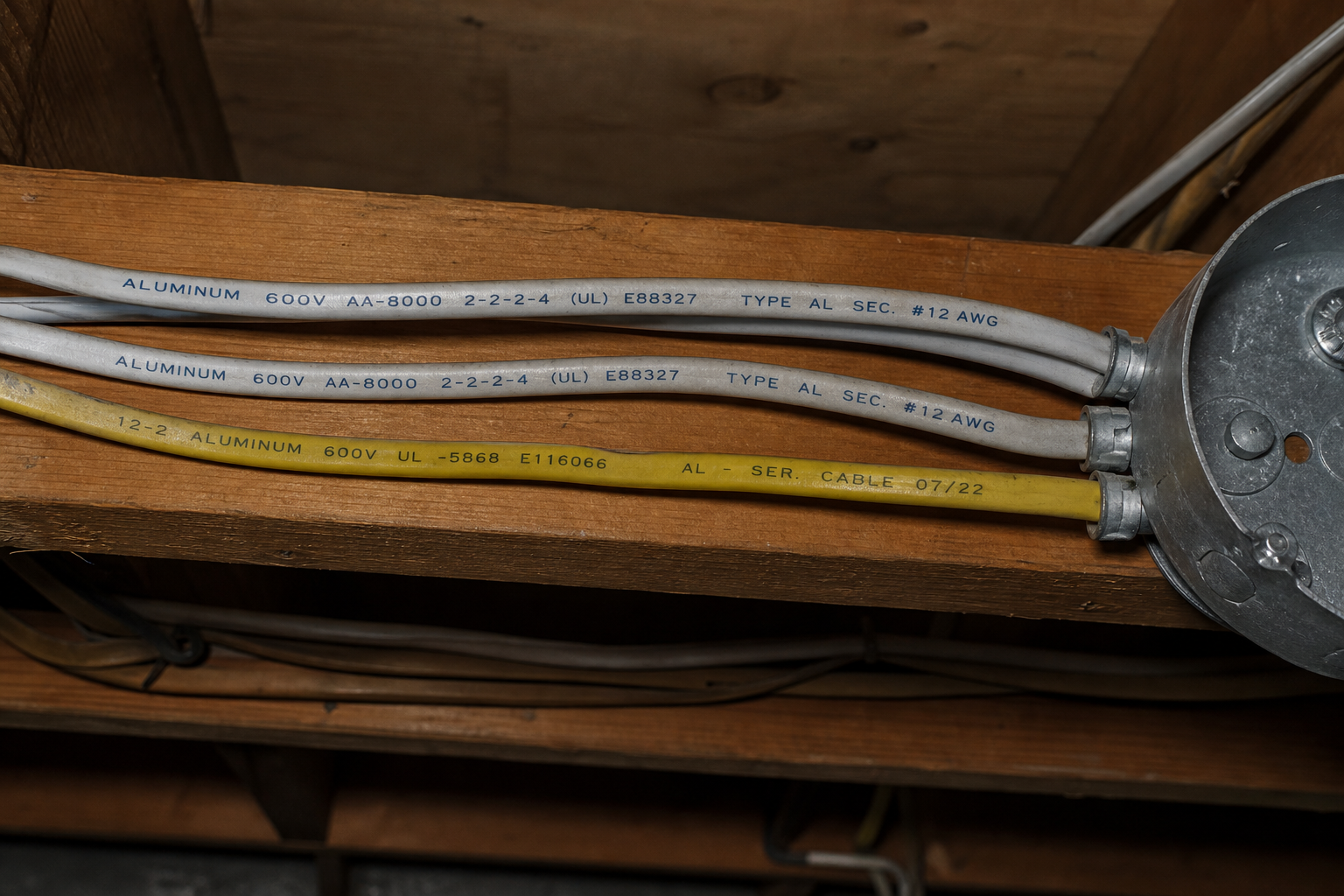
Go to an unfinished area like the basement, attic, or garage. Look at the outer jacket of the NM cable (brand-name Romex is the most common). You’ll see markings every few feet. If the conductors inside are aluminum, the jacket will say “AL” or “Aluminum” right there in the printing.
If you see “CU” it’s copper. If you see “CU-clad” or “Copper-clad,” that’s copper-coated aluminum — a different product with a different risk profile, though it still needs proper installation and CO/ALR rated devices.
Solid aluminum wire in 1960s-70s homes is usually:
- No. 10 AWG for 20-amp circuits (copper would be No. 12)
- No. 12 AWG for 15-amp circuits (copper would be No. 14)
The wire is one gauge size heavier because aluminum isn’t as conductive as copper. If you see those sizes and the “AL” marking, you’ve confirmed it.
If you’re not comfortable checking, a licensed electrician can identify it in about 30 seconds during a service call.
Warning Signs — and the Problem With “No Warning Signs”
The trouble signs that everyone talks about are real and serious:
- Face plates that feel warm or hot to the touch
- Flickering or dimming lights that aren’t tied to a specific appliance
- Burning plastic smell near outlets or switches
- Buzzing sounds from switches or receptacles
- Frequently tripped breakers on the same circuits
Any one of those needs immediate attention from a licensed electrician. Do not flip the switch again. Do not plug something else in. Call someone.
But here’s the thing the CPSC and every experienced electrician will tell you: failing aluminum-wired connections often give no warning signs at all. The CPSC’s own publication states it bluntly — connections can overheat to the point of fire without any flickering, buzzing, or warm plates beforehand. That’s what makes this different from most electrical problems. You can’t always see it coming.
Your Options for Remediation
If you have aluminum wiring, you have four paths forward. I’ll rank them from most thorough to least, and be honest about the trade-offs of each.
1. Full Rewire to Copper
This is the gold standard. A qualified electrician pulls new copper branch circuits through the walls, and the old aluminum wire gets abandoned in place. Every outlet, switch, junction box, and fixture gets fresh copper connections.
Pros: Permanent solution. Zero ongoing worry. Best for resale value. Most insurers are happy. Cons: Expensive — typically $8,000 to $15,000+ depending on house size, accessibility, and local rates. Disruptive if you have finished walls.
Full rewire makes sense if you’re already renovating, replacing drywall, or if your insurance carrier requires it for coverage.
2. COPALUM Crimp Connectors (Pigtailing)
This is the CPSC’s preferred repair method short of a full rewire. A certified technician uses a hydraulic crimp tool with over 10,000 lbs of force to cold-weld a short copper pigtail onto the end of each aluminum wire. Then the copper pigtail connects to the outlet or switch as normal.
Pros: CPSC-approved permanent repair. Over 25 years of field testing. Creates a genuine cold-weld joint that doesn’t depend on screw torque or anti-oxidant compound. Cons: Must be done by a factory-trained installer — not every electrician is certified. Requires accessing every single connection in the house. Can be hard to find certified installers in some regions.
Manufacturer: TE Connectivity, (800) 722-1111. They maintain a list of authorized installers.
3. AlumiConn Connectors (Screw-Type Pigtailing)
These use a setscrew connector (torqued to spec with a screwdriver) to join the aluminum wire to a copper pigtail. The CPSC considers this an acceptable alternative when COPALUM isn’t available.
Pros: Easier to find qualified installers. No specialized hydraulic tool required. Lower cost than COPALUM in many markets. Good lab-test results. Cons: Lacks the long-term track record of COPALUM (newer product). The connection depends on proper torque, which means the installer needs to use a torque screwdriver — not all do.
Manufacturer: King Innovation, (800) 633-0232.
4. CO/ALR Rated Devices
These are switches and receptacles specifically designed to accept aluminum wire directly. They’re marked “CO/ALR” on the mounting strap.
Pros: Cheapest option. Quick swap-out. Cons: The CPSC tested CO/ALR devices under load and some failed. They consider this a temporary risk reduction, not a permanent repair. I agree. CO/ALR devices are better than nothing, but they’re a band-aid, not a fix.
What About Pigtailing With Wire Nuts?
Don’t do it. The CPSC tested this. A significant number of twist-on connectors (wire nuts) used to join aluminum and copper overheated severely under load. Some caused more failures than the original aluminum-to-terminal connections. The only approved pigtailing methods are COPALUM and AlumiConn. If an electrician suggests using wire nuts as a fix for aluminum wiring, get a second opinion.
Insurance and Real Estate
This is the part that surprises most homeowners. Aluminum wiring can affect your ability to get or keep homeowners insurance. Some carriers will write a policy with a higher premium. Others will require an inspection. A growing number will flat-out refuse to insure a home with single-strand aluminum wiring unless remediation has been completed.
If you’re selling a house with aluminum wiring: disclose it. Don’t try to hide it. Home inspectors check for this as a matter of course, and in many states, failure to disclose is grounds for a lawsuit after closing. Some buyers will walk. Others will negotiate a credit for remediation. The worst outcome is an undisclosed aluminum wiring problem that surfaces during the buyer’s inspection and kills the deal at the 11th hour.
If you’re buying a house with aluminum wiring: use it as a negotiating point, but don’t assume it’s a dealbreaker. Get a licensed electrician to evaluate the connections — not just identify the wire, but actually pull a few outlets and check the condition. A house where connections have never been disturbed is a different proposition from one where someone DIY’d some outlets with non-rated devices 20 years ago.
What NOT to Do
- Don’t DIY. Aluminum wiring repairs require torque-controlled connections, anti-oxidant compound, and devices rated for aluminum. A homeowner with a screwdriver and YouTube is not qualified. The risk of electrocution and fire is real.
- Don’t use “purple wire nuts” or any other wire nut advertised for aluminum-to-copper connections. The CPSC has not approved them, and independent testing has shown failures.
- Don’t ignore it. Even if everything works fine today, the connection deterioration is cumulative and can accelerate without warning. The CPSC’s 55x statistic is not about old abused wiring — it’s about houses where the wiring had never been touched.
FAQ
Q: Is aluminum wiring always dangerous?
A: Not always, but the risk is real. The CPSC estimates that homes with pre-1972 aluminum wiring are 55 times more likely to develop fire hazard conditions at connections compared to copper. Many aluminum-wired homes operate safely for decades — but enough don’t that ignoring it isn’t smart. Get an inspection and make an informed decision.
Q: Can I sell a house with aluminum wiring?
A: Yes, but you must disclose it. Aluminum wiring is considered a material defect in most states, and failing to disclose it opens you up to legal liability. Some buyers will negotiate, but a clean disclosure upfront keeps you in control of the transaction.
Q: Will my insurance cover a house with aluminum wiring?
A: It depends on the carrier. Some will insure at standard rates. Others require a professional inspection first. A growing number of insurers will not write a new policy on a home with single-strand aluminum wiring unless remediation (COPALUM, AlumiConn, or full rewire) has been completed. Check with your agent before you commit.
Q: What’s the difference between COPALUM and AlumiConn?
A: COPALUM uses a hydraulic crimp tool to cold-weld a copper pigtail to the aluminum wire. It’s the CPSC’s preferred method with 25+ years of proven reliability. AlumiConn uses a torque-controlled setscrew connector — it’s the CPSC’s acceptable alternative, easier to install and more widely available, but lacks the same long-term field history. Both are considered permanent repairs when installed correctly.
Q: Can I just replace the outlets with CO/ALR rated devices and call it done?
A: Not permanently. CO/ALR devices reduce the risk at those specific connections, but the CPSC considers them a temporary improvement, not a permanent repair method. They failed in lab tests under load. CO/ALR is better than nothing, but it’s not the same as COPALUM, AlumiConn, or a full rewire.
Q: How much does aluminum wiring remediation cost?
A: Full rewire runs $8,000–$15,000+ depending on house size and accessibility. COPALUM pigtailing is typically $3,000–$6,000 for an average home. AlumiConn is usually in the same range or slightly less. CO/ALR device swaps are cheaper but not a permanent fix. Get 2–3 quotes from licensed, experienced electricians and compare scope, not just price.
Q: Was aluminum wiring used after the 1970s?
A: Occasionally, but it’s rare in residential branch circuits after about 1975. Once the fire hazard data became public and the CPSC issued warnings, builders stopped using solid aluminum for 15- and 20-amp circuits. However, aluminum is still common in larger service entrance cables, feeder circuits, and manufactured homes. If your house was built after 1980, aluminum branch wiring is unlikely but not impossible.
Bottom Line
Aluminum wiring is a known hazard with known fixes. It’s not a death sentence for your house or your bank account, but it’s not something you should ignore either. Start with identification — know what you have. Then get a qualified electrician to assess the connections, not just the wire type. From there, choose the remediation path that fits your budget, your timeline, and your risk tolerance.
You don’t need to panic. You do need a plan.